John Robinson [1935 - 2007], artist and co-founder of the Bradshaw Foundation, first met Dr. Jean Clottes in 1994 in Flagstaff, Arizona at the International Rock Art Congress hosted by the American Rock Art Research Association (ARARA), where the Foundation was promoting its recently published book 'Bradshaws - Ancient Rock Paintings of North-West Australia'. What began as a formative collaboration between the eminent French prehistorian and John Robinson, Director of the Bradshaw Foundation, soon became a strong friendship.
In 1996, only 4 years after Chauvet's discovery, Jean Clottes and his scientific team were chosen by the French Ministry of Culture to investigate the cave and its extraordinary cave paintings and pristine archaeological artefacts. In 1999, merely three years later as the preliminary results of Jean Clottes' scientific analysis of the Palaeolithic cave paintings were sending shock waves through several academic fields around the world, John Robinson was honoured to be invited into Chauvet Cave. Clearly, Dr. Jean Clottes was keen to observe the insight of a modern day artist; for the artist, he was about to embark on one of the greatest experiences of his life.
John Robinson [1935 - 2007], artist and co-founder of the Bradshaw Foundation, first met Dr. Jean Clottes in 1994 in Flagstaff, Arizona at the International Rock Art Congress hosted by the American Rock Art Research Association (ARARA), where the Foundation was promoting its recently published book 'Bradshaws - Ancient Rock Paintings of North-West Australia'. What began as a formative collaboration between the eminent French prehistorian and John Robinson, Director of the Bradshaw Foundation, soon became a strong friendship.
In 1996, only 4 years after Chauvet's discovery, Jean Clottes and his scientific team were chosen by the French Ministry of Culture to investigate the cave and its extraordinary cave paintings and pristine archaeological artefacts. In 1999, merely three years later as the preliminary results of Jean Clottes' scientific analysis of the Palaeolithic cave paintings were sending shock waves through several academic fields around the world, John Robinson was honoured to be invited into Chauvet Cave. Clearly, Dr. Jean Clottes was keen to observe the insight of a modern day artist; for the artist, he was about to embark on one of the greatest experiences of his life.
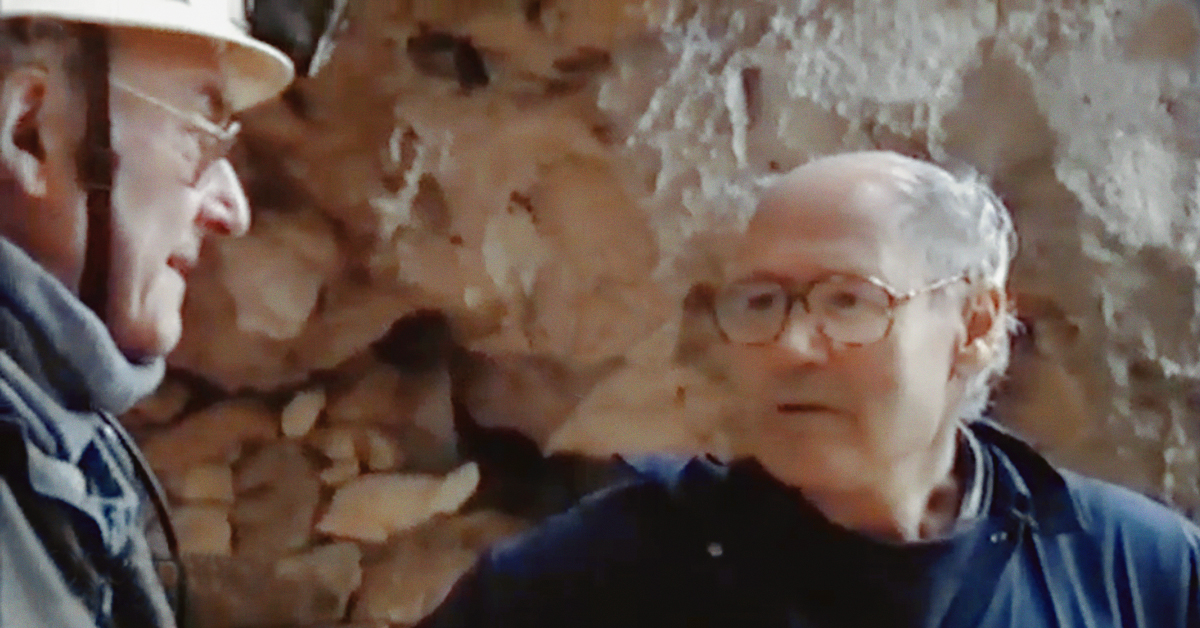
When Jean Clottes invited me to join his Team for the Investigation of the Chauvet Cave paintings, that was discovered on the 18th December 1994, he warned me that I would not be able to visit until the entrance had been widened, and he thought that this would take at least 18 months. That didn't worry me in the least as after seeing the photographs of the Chauvet Cave paintings, I would have been happy to have waited three years, or five. Ten might have been asking too much!
Also I had heard Jean's own story of his first visit to the cave with Jean-Marie Chauvet, Eliette Deschamps, and Christian Hillaire. I don't have any trouble with tight spots in caves, in fact rather enjoy the challenge, but I am not sure that squeezing through a foot high down hill letterbox for 25 feet was quite my cup of tea. I was happy to wait until the tunnel had been widened.
How do you prepare yourself for a visit to see the oldest known cave paintings in the world especially when you have seen the photographs and know that you are going to see works of astounding beauty? I had over a year to prepare myself for what was going to be one of the great artistic experiences of my life, as was my visit to the Sistine Chapel.
I decided that where possible I would avoid looking at any photographs of cave paintings from Chauvet for the coming year. Unfortunately I would occasionally see pictures in magazines, but I purposely didn't study them, only read the articles. I wanted the paintings to be as fresh to my eyes as it was possible. At last the appointed day arrived, the 18th of October 1999 was a glorious sunny day.
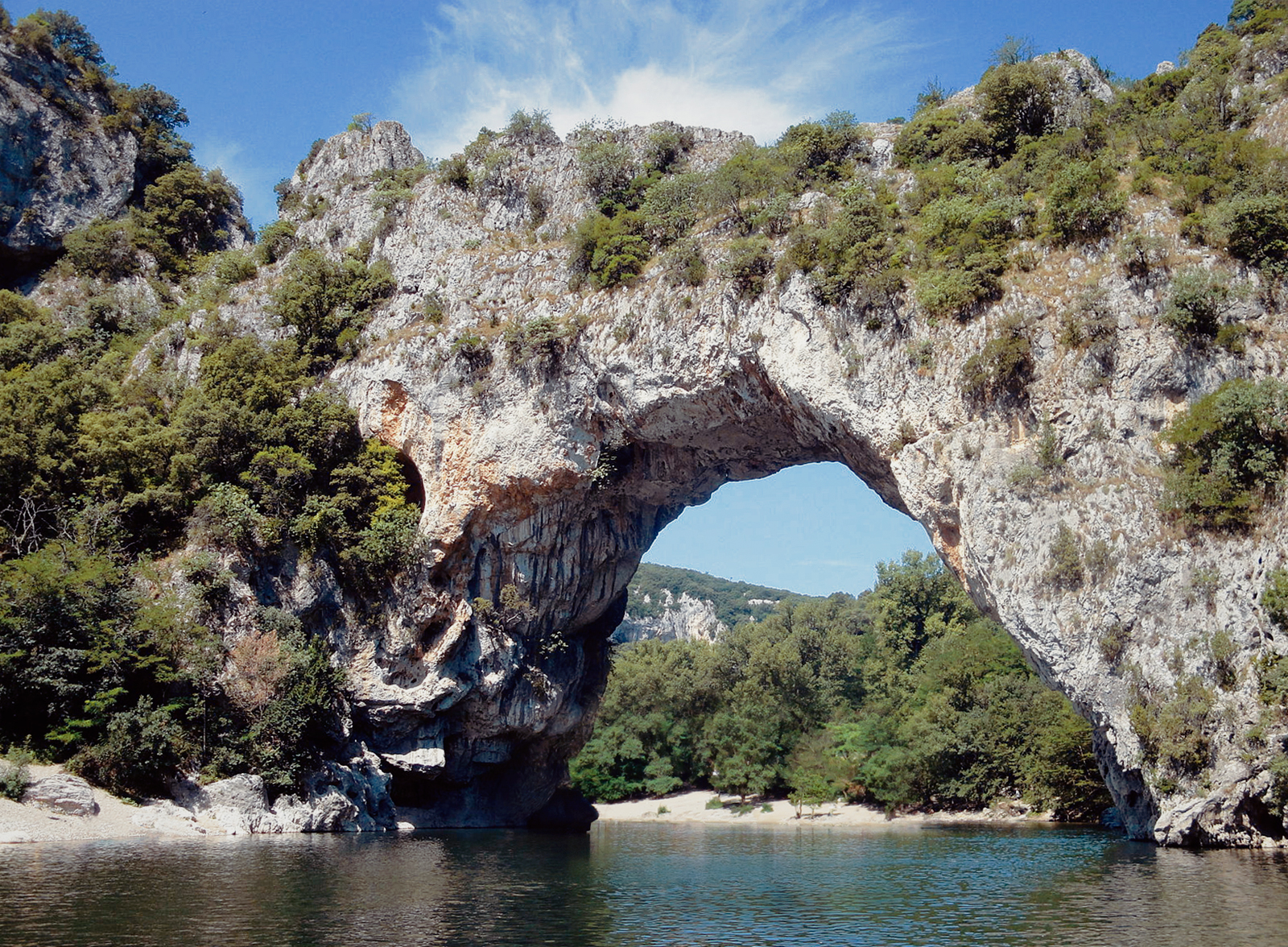
My wife and I drove south through France from Lyon along the Rhone River, and turned west at St Just into the Gorges de L'Ardeche. I wanted to get the feeling of the environment in which the cave is situated. The Gorges is one of the most spectacular Canyons in Europe, and can be well viewed from several vantage points along the road that follows the top of the sheer cliffs, from where you can look down on the crystal clear river.
At the head of the canyon, just before reaching Vallon-Pont-d'Arc, the road descends to the river. Rounding a bend we were suddenly confronted with a glorious freak of nature, the Pont-d'Arc. The river has cut straight through a rock barrier; thus creating an enormous and majestic Arch that spans the flow. A canoe was being paddled under the arch the moment we arrived, giving the scene a remarkable perspective. The Arch of Pont d'Arc is a wonder to behold. What would it have meant to the Chauvet People 30,000 years ago? Would it have represented an animal as Jean suspects?
Possibly, as in the caves the artists had often used the natural form of the rock surface to depict the animals in the Chauvet Cave paintings. I looked at the Arch and immediately saw a Lion. We found a quiet little hotel in old Vallon, and I rang Jean. He had established his HQ in a Municipal Holiday Camp, his team had set up their laboratories for the study of the cave. Jean asked me to meet him at 0830 in a car park near the Arch.
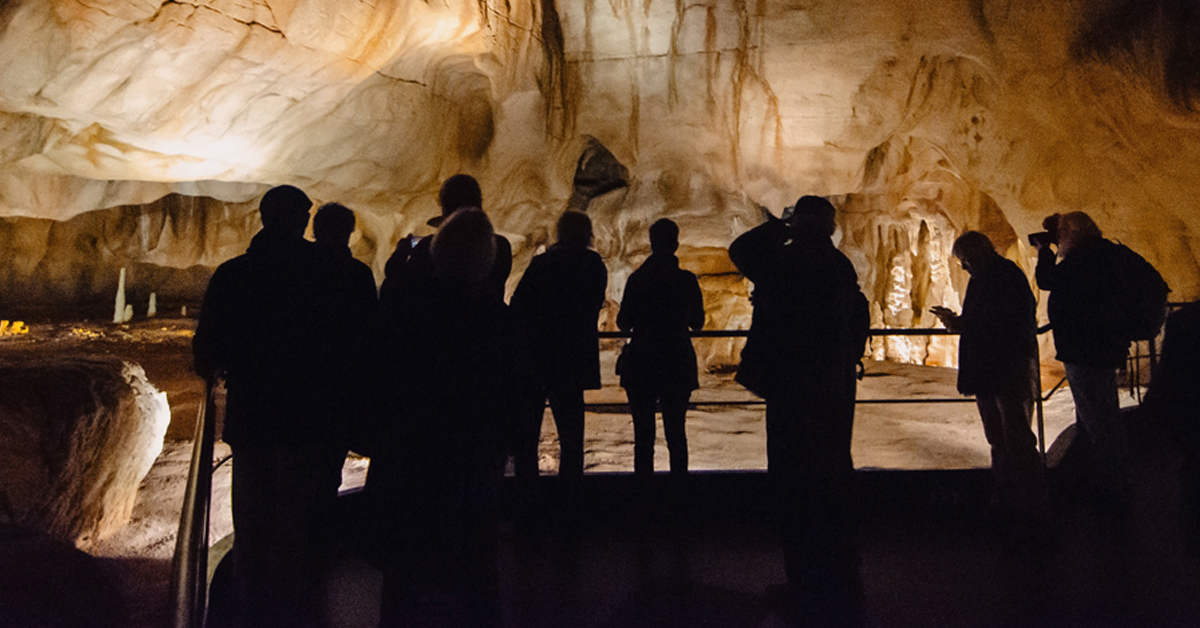
The paintings of the Chauvet Cave are an archaeologist's dream come true as the whole cave is in a pristine condition, untouched by man for possibly 27,000 years, as the only visitors since the cave paintings were done have been the Bears, who used the cave for their winter hibernation. Every possible precaution is being taken to disturb nothing. As soon as the entrance had been widened, aluminium catwalks were brought in and erected on six inch high legs to protect the floor of the cave. A network of scientific apparatus constantly monitors the temperature, and humidity of the cave.
I awoke to a dull wet day. It had rained all through the night, so now the Canyon was full of swirling mist. I arrived at what I thought must be the right car park to find it empty, so drove on down the road to see the Arch in this totally different light. It was shrouded in vapour and very menacing. Not finding another car park I returned and saw Jean and David Lewis-Williams waiting for me, plus a film crew, who proceeded to record our happy meeting!. The car park is beside a beautiful vineyard, which in turn ends in the sheer cliff of the canyon.
The vine leaves had started to turn golden and sparkled with drops of water. Across the face of the cliff ran a river scoured cutting, and it was up this that we were going to pass to the entrance of the cave, which was situated towards the top of the canyon.
I Loaded up with equipment, the seven members of the team that were going to work in the cave that day, set off through the vineyard, to the track that led up to the cutting. The rain had stopped but the leaves of the scrub oaks were saturated with water, so that every time you pulled on a branch to heave yourself up the steep incline, down would come a shower of droplets. Slowly we climbed up the goat path and arrived at the cutting.
The water worn cutting is some 200 yards long and runs across the face of the cliff at about 15 degrees incline. Way below lay the vineyard, then the river, and then the opposite cliff. It was a breathtaking view, with the sun just beginning to struggle through on this misty morning. I wondered about all the people who had taken this path 30,000 years ago, as surely this must have been the way up to the Chauvet Cave then, as it is now.
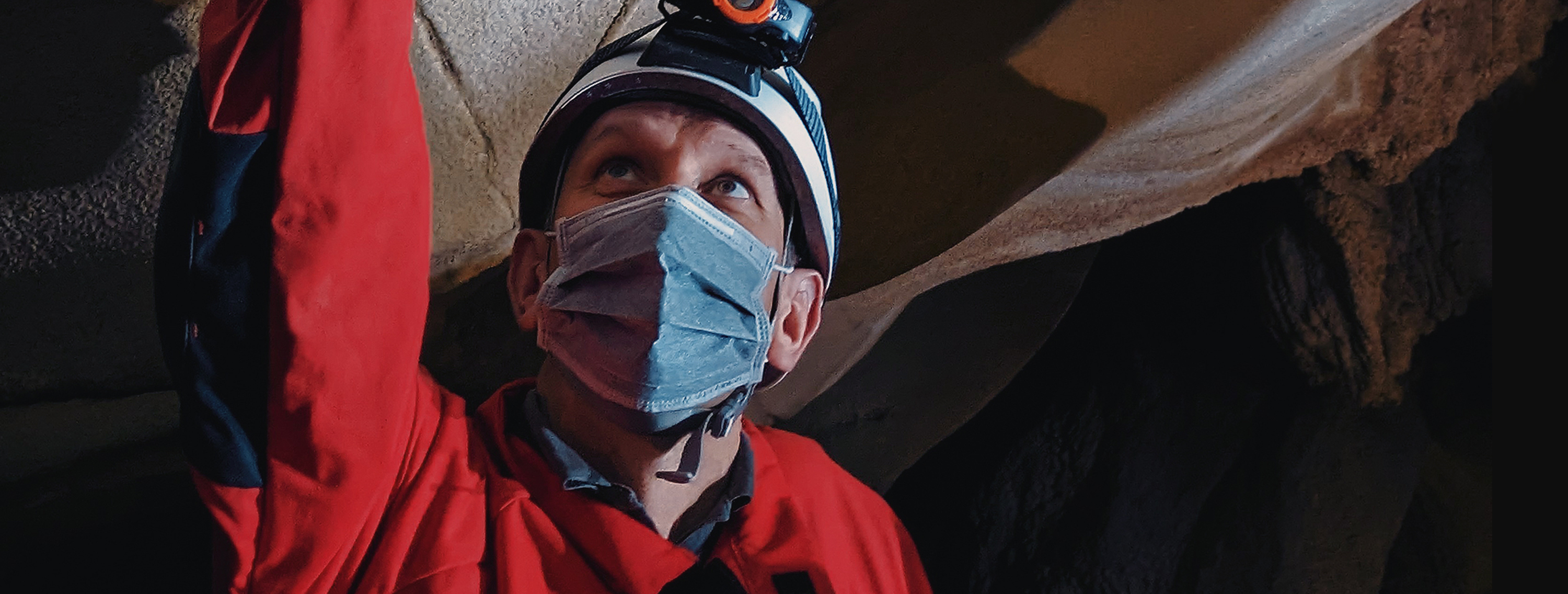
Once past the cutting the going got a little steeper, but we soon arrived at the store cave that is to the right of the Chauvet Cave entrance. The journey had only taken half an hour. Here the team unloaded and we pulled on our boiler suits. A new catwalk of stainless steel and wooden planking led off to the left for about 50 feet, ending in a Bank vault door. This was the Government's precaution against the treasure of art being tampered with by unauthorised visitors. The electronic door opened and I stepped inside the Chauvet Cave. What a moment, I was inside.
I couldn't really believe it. The room was about the size of a 10 person elevator, but also housed a giant fuse box and battery charger, so was very cramped. Rubber shoes were stacked to the right, helmets to the left, and people in the middle. Boots were removed and replaced with rubber shoes in an effort to try and keep the outside pollen from contaminating the ancient pollens inside.
Helmet on and battery strapped around my waist, I followed Jean on all fours into a three foot wide rabbit hole. This was the widened tunnel made to allow easier access for humans and the alloy catwalks. It runs steeply down hill for about 40 feet and ends in the gaping mouth of a well. Attached to the roof above the well is a dead-man winch with a safety belt that goes around your waist, so that if you slip going down the ladder, it will stop you falling the 30 feet to the bottom!
I looked into the black hole in front of me, harnessed up tightly, shuffled myself round, and started down the ladder, which is attached to the smooth water polished sides. On reaching the bottom I found myself standing in a James Bond film set on an alloy platform. I undid the safety belt, watched it shoot up the shaft for the next person, then turned and looked out into the Chauvet Cave. My light pierced the blackness to reveal a wonderland of stalactites and stalagmites. The colours were soft golden yellows and pinks. Sparkling white crystals glinted in the beam of my helmet torch. It was an Aladdin's cave.
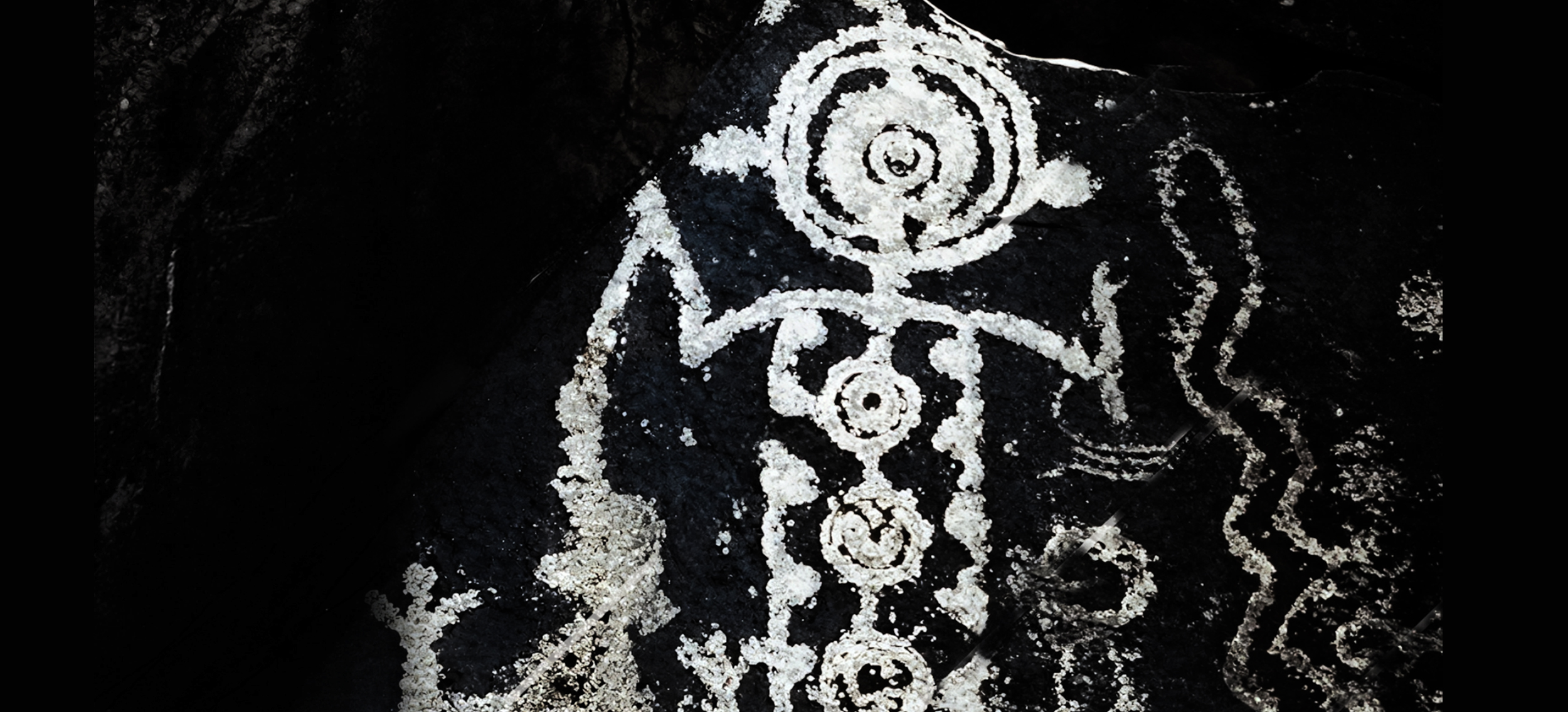
Following Jean, David and myself set off down the catwalk as far as it has yet reached, before stepping off onto a two foot wide black plastic strip. These strips are the paths that lead around the Chauvet Cave. No one is allowed to step off the strip without removing the rubber shoes, and proceeding only in socks. By this means it has been possible to protected 99.9 % of the cave floor against damage of any kind. The plastic will soon be replaced by the alloy walkways. Jean led us to the first large wall of red Dots in the Chauvet Cave. What is their meaning?
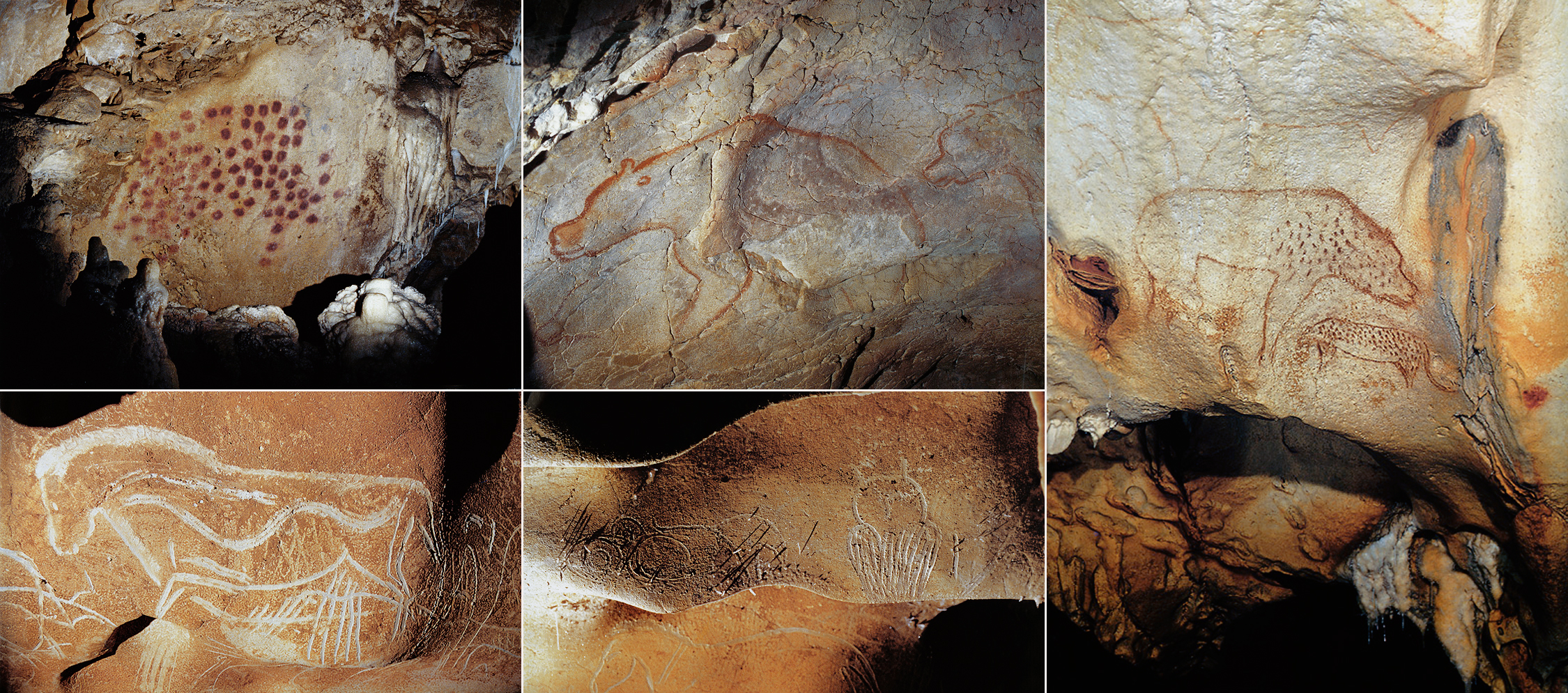
No one knows, but they give you a wonderful sense of communicating with the makers of the Chauvet Cave paintings, especially as you can occasionally make out that the Dots have fingers. It seems as though the daubers first put the red paint on their palms and then looks like they slapped their hands against the wall. Some people were a bit careless and got paint all over their hand, thus leaving imprints of their fingers as well.
The paint must have been quite fluid as there are occasional paint runs, which makes it all very human. Another great panel of dots is thought to be by one Chauvet Cave artist, as the handprints all seem to be the same. This panel to the left has a vague resemblance to a great Bison, but it could be just a coincidence.
Still following, Jean led us over a jumble of stalagmites and rocks into a recess. Here on the floor was a small trolley that ran on rails. "Lie down in the trolley John and pull yourself in" Simple?. No. To begin with the trolley contained a large puddle, a definite designer fault, and secondly Jean had not released the brake! However with much pulling and grunting I managed to get the trolley to the ends of its rails. "Look to the left" was Jean’s next command.
I looked and found myself staring into the eyes of the most beautiful Bear. The red outline is pure and graceful. I was about two feet from the painting and absolutely bowled over. "There is another one behind it", Jean called. I turned and saw another red Bear. What a pair. How did the artist draw such wonders in such a confined space, and why?
David was waiting and I had to back out, but first Jean leant in and took a photograph. Still in shock I followed Jean back along the strip, and we passed into the second chamber. This is huge and yet there is not a single painting on the Chauvet Cave wall, only calcite encrusted bones and skulls of Bear, the odd enormous tooth, and the skeleton of one tiny bird or bat. Everywhere there are Bear nests, which they have dug out for hibernation. We arrived at the end of the chamber and came to a rock wall that had a womb like hollow in it. At the right hand end of the five feet long and two feet high womb are about 20 red fingertip dots. On the left hand end is a rock crack with a small piece of bone pushed into it.

We crossed over to the far wall of what is really the entrance to a smaller passage chamber. Here Jean introduced me to the Cheetah and the Hyena. Discovering these two paintings was a unique event, as these animals have never been depicted in any other cave.
Of course that makes them exciting, but for me the real thrill was to see the artistry. The Hyena is just as mean looking as his descendants are today, with their run away backsides, and the Cheetah just as slinky, with its drooping shoulders. The Hyena is just as mean looking as his descendants are today, with their run away backsides, and the Cheetah just as slinky, with its drooping shoulders. Across the chamber to the right is a wonderful large red Rhinoceros, a possible Insect 18 inches high, and a positive red Hand with a wonderful arch of 20 or so red fingertip dots beside it.
At the end of this panel, but significantly separate, is a negative Hand done by spraying paint over the hand when it is against the rock, rather than pressing the wet painted hand against the wall. The negative Hand to me is very feminine. The fingers are abnormally long and the third finger is unnaturally bent the wrong way in an elegant arc out towards the little finger. The positive Hand is stubby and masculine. This section of the cave face seems to have been reserved for symbols.
On into the Candle Gallery, so named for the stalagmites. Here not a single painting or symbol has yet been found. Why? There are walls here that would have made wonderful canvases. I started to get the feeling that all the paintings in the Chauvet Cave were very well organised and planned. After passing through the 30 yard long Candle Gallery, we stepped out into the enormous Chamber Hillaire. It is huge, 30 yards across, 40 yards long, and very high. Right in the middle of the Chamber there is a gigantic pit where the floor has caved in. The circular hole is 20 feet across and at least fifteen feet deep. Shining my headlamp down I could see wide cracks in the floor of the pit amongst a tumble of rocks. The edges are crumbly and unstable. It all looked very dangerous to me and quite impossible to get out if you fell in.
Looking across to the other side of the pit I could see the layers of silt that had been laid down over aeons of time to build up the flat floors of the Chauvet Cave. This is one of the features of the Chauvet Cave that I have always recognised as giving it such a religious air. Walking around in the Chauvet Cave is a bit like walking around in churches, because both have flat floors, both have paintings on the walls, and both have sacred places in special niches.
The pit is obviously continuing to slowly expand, as on a low section of the roof of the cave is a panel that sticks well out beyond the pit edge. On this panel is engraved one of the most remarkable and imaginative drawings in the cave, an Owl, shown looking back over his shoulders with its head twisted 180 degrees from the front. Of course we all know that owls can do this, but if asked to draw an owl, how many of us would depict it like this? I suggest not very many, if any. Yet the artist who drew this owl did, and in doing so truly showed how brilliant he was at draftsmanship, but also how incredibly imaginative he was. I was becoming very much aware of the fact that I was in the presence of Works done by Artistic Masters.
Following along the plastic strip and crossing over to our right, Jean led us to a wall of engravings. One of these was of a beautiful horse, done with a half inch wide chisel type tool, perhaps a stick, perhaps a bear rib bone. The lines are free and flowing, no trial and error, just clean sweeps of the tool. Along the length of the horse are some wavy lines, starting from the right as three and finishing as two on the left. These I think were done with the artist’s fingertips. Holding my right arm out and starting from the left, I attempted to imitate the action, without touching the wall of course. I started with my index and third finger, pretending to push them into the wet surface as my hand passed before my face going right, my first finger automatically came into contact with the surface, creating the third line.
We walked back, skirted around the pit, and approached the end of the chamber. To our right was a raised platform that led to the entrance of a black tunnel, some 10 feet high and 15 across. On the left wall of the entrance of the tunnel is a wonderful painting of a rhinoceros with a black belt around his middle. On the right a Megaloceros, an extinct type of giant Moose like creature with spiky antlers. This was the entrance to the last chamber, the Hall of the Sorcerer.
Jean led us past the black tunnel and its forbidding entrance on towards a chamber off to the left, the Bear Skull Altar. Again there is a natural entrance to this chamber, stalagmites to the left and a wall to the right.
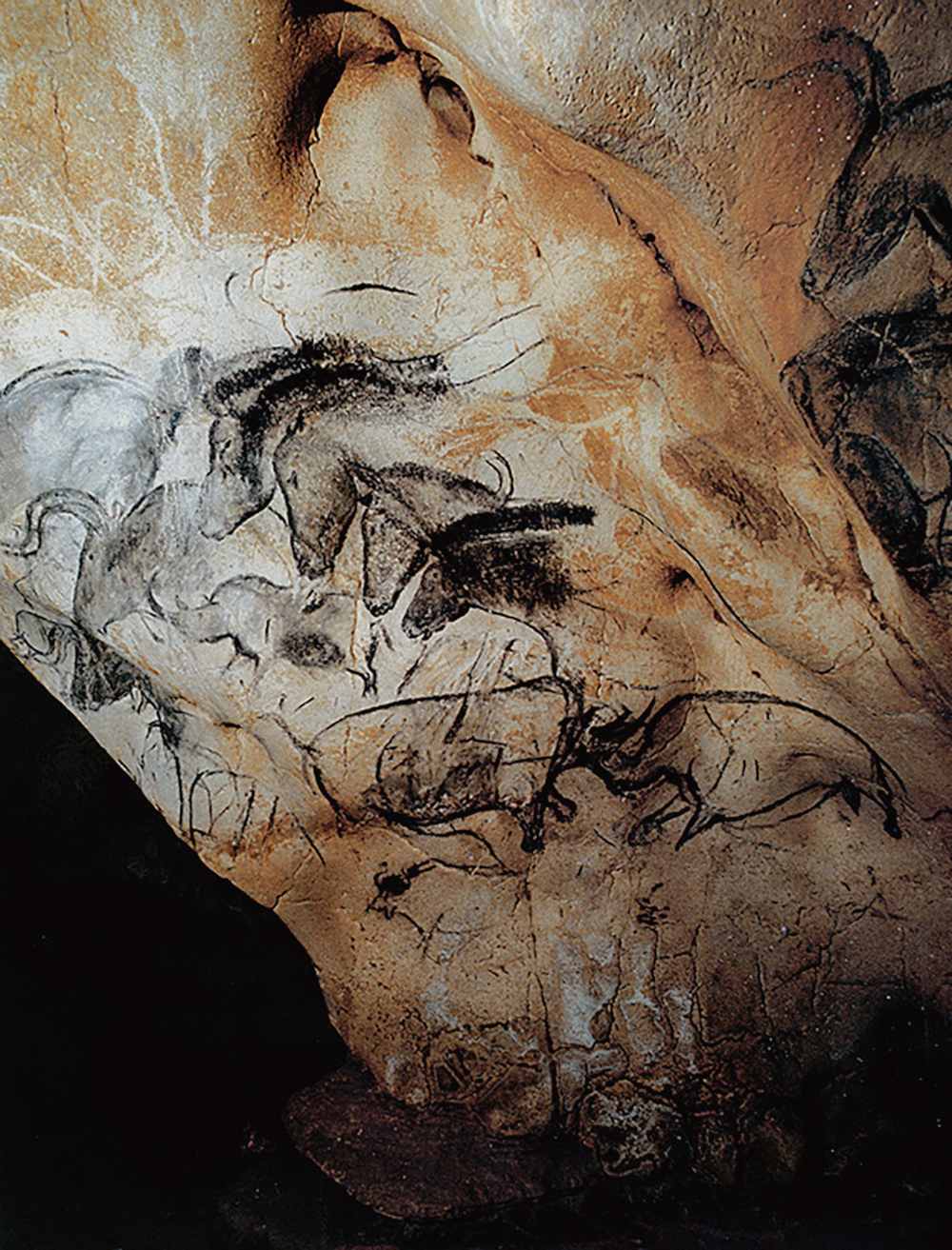
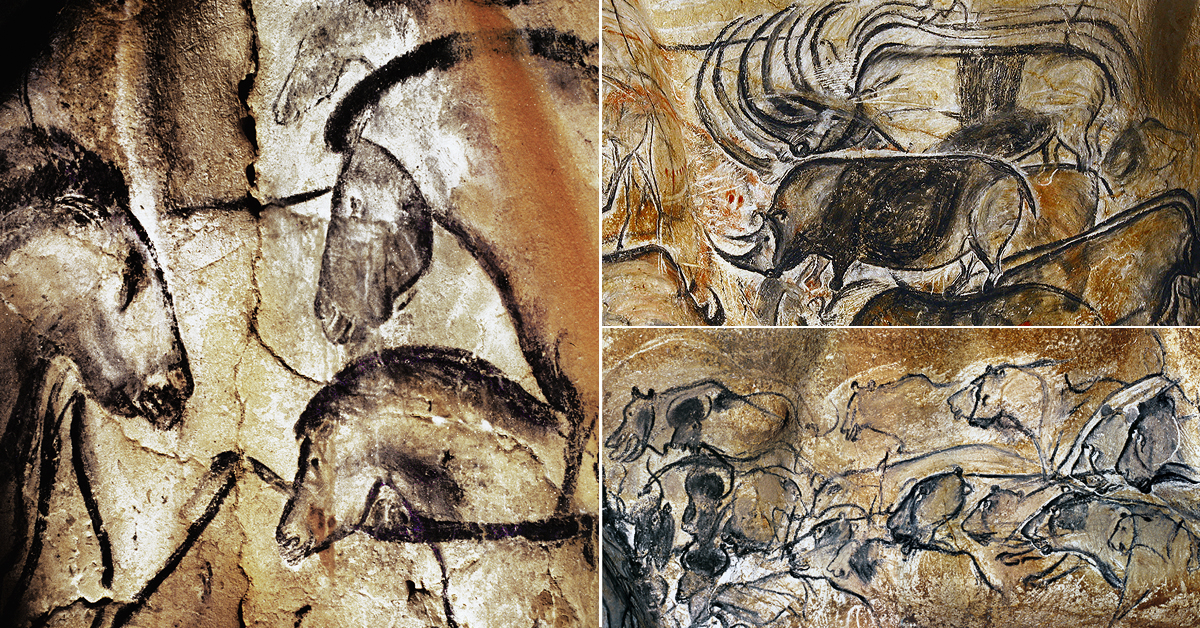
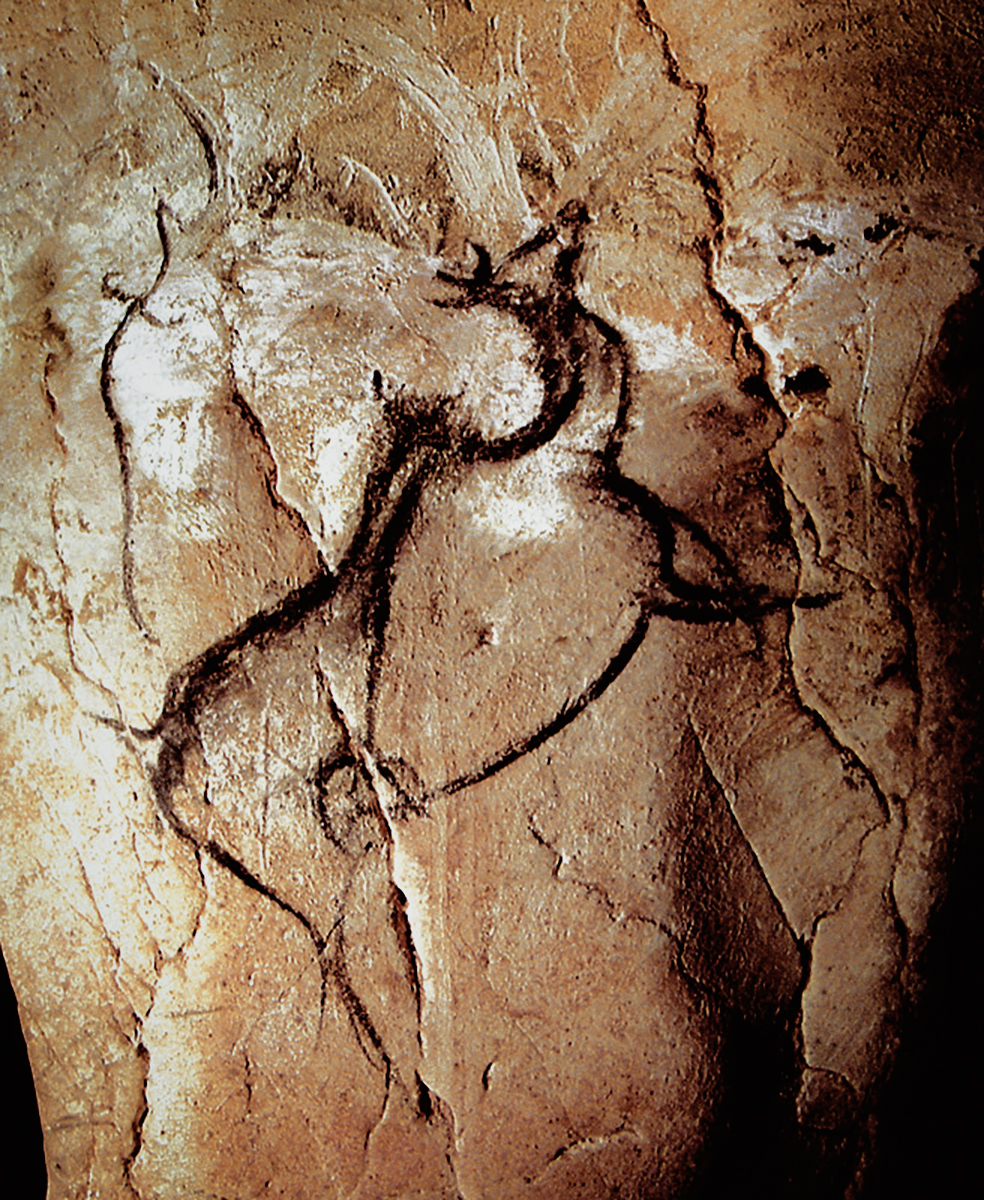
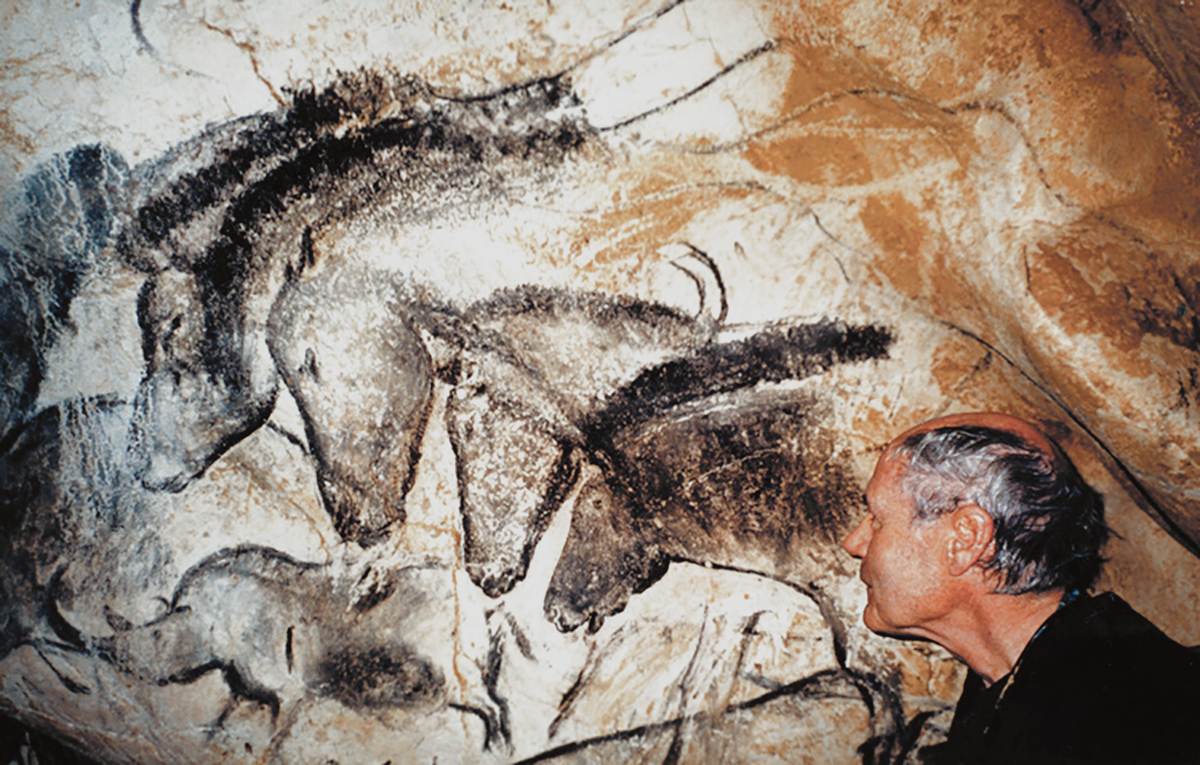
I followed Jean, with my head lowered so that my helmet light shone on the plastic path, until he stopped and asked me to squeeze past. Looking up I found myself gazing straight into the eyes of the Horses. I don’t think I've ever been so moved by a work of art in my life. Recovering I started to take in the rest of the cave paintings on the wall. Some 15 feet long and 10 high, this whole wall of the Chauvet Cave is a giant canvas full of wonderful creations.
Next to the Horses are two incredible Aurock heads (extinct giant cows), and below them, the famous Fighting Rhinoceros. The panel is without doubt one of the great masterpieces of Homo sapiens Art, besides being the oldest. This is where the sample of charcoal was taken from that gave the date of 32,000 years old.
Jean invited me to remove my shoes and step forward onto the calcite floor. I was now a foot away from the Horses heads. Was it the pain of the sharp points of the calcite biting into the soles of my feet that was making me incredibly aware, or my proximity to the cave paintings?
I studied the lines of black edges, and the use of smudging to produce shadow. Then I saw that the artist had highlighted the outer edge of the drawing by chiselling into the white rock surface. The incising immediately brought to mind the wonders of Egypt, but they were done 3,000 years ago. Here I was looking at rock art 10 times older, 30,000 years old.
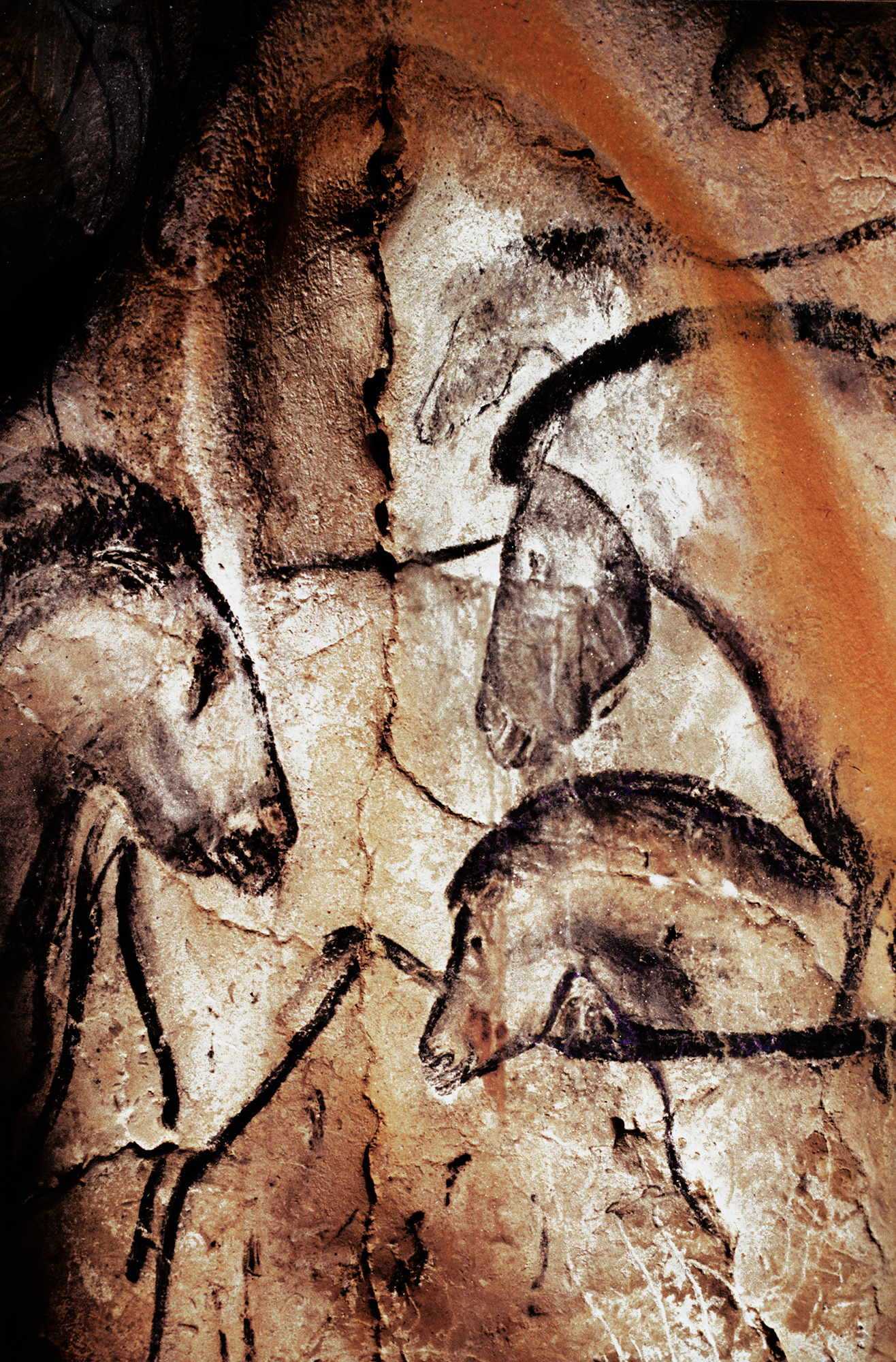
I moved to the right around a slight edge in the wall, to see what I call the Chagall Horses and the Lion. More wonderment, and then another superb Rhinoceros coming out of the wall at me. I stepped back from the wall and tried to take in the whole scene and all the grandeur that it holds. What a wonderful discovery, and what a privilege to be here looking at it.
More than a little punch drunk, still with no shoes on, Jean led me into the Altar Chamber of the Chauvet Cave. Carefully stepping where Jean stepped, avoiding the little walls of calcite, we moved out into the middle of a chamber that is some 25 feet across and broad, and almost circular. Around the backside is a raised area that almost looks as though it had been made to seat an audience.
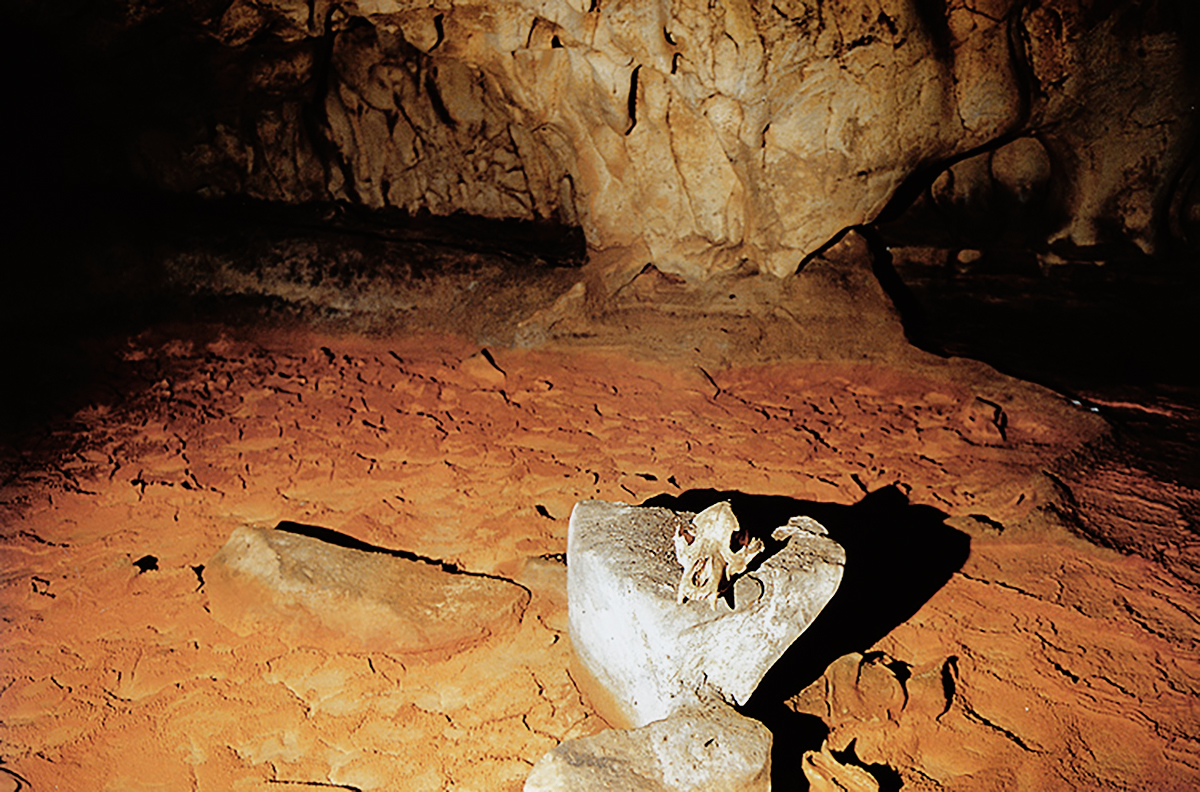
In the middle of this chamber is the Altar on which is placed a Bear skull. On the floor around the Altar are 36 other Bear skulls. Obviously they had not all died in this one chamber, but must have been collected from around the Chauvet Cave, or perhaps came from outside kills. For me this was a place where people gathered for some really important ceremony connected with the Bears. I began to get a picture in my mind of the social life of the Clan. The Altar is roughly two foot square on top and two foot high. I squatted down in front of the skull and looked into the eye sockets. With the aid of my pocket torch I could see the surface of the rock beneath the skull.
It was covered with tiny lumps of charcoal and grains of fallen calcite, which were exactly similar to the surface not covered by the skull. A human must have put the skull there. Jean took one of these small pieces of carbon to have it dated. The carbon was 35,000 years old.
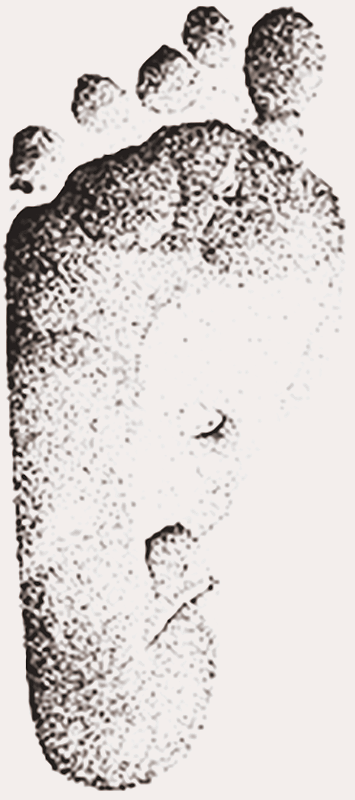
Had the artists come here to get the water needed to mix with their red and black paints? Or had they had a young apprentice artist with them that they sent to fetch the water? The question can be asked because on the way back Jean showed me the oldest Homo sapiens footprint ever yet discovered. Firmly impressed into the soft grey clay is the left footprint of an 8 year old boy. Scientists can tell the sex and age from the size and shape of the impression. I bent down and held my hand over the footprint. This particular Robinson Crusoe was enthralled by this 27,000 year old boy Friday. The imprint of the big toe is precisely like all the big toes of the hundred or so children that I have sculpted over the last 30 years. His second toe was longer than the big toe, giving him what sculptors call a Grecian foot, which in Athenian times was always thought to be a sign of good breeding. I felt an incredible physical bond between myself and the young man who had made his mark here in the clay all those years ago.
We had been in the cave now for three hours. It was time to leave and have some much needed lunch. I was glad to take a break as my head was in a whirl. Later we would return and descend into the Holy of Holies, the Sorcerer’s Sanctuary.
We soon arrived back at the bottom of the shaft, clipped on to the safety harness, climbed up the ladders, and crawled back up the tunnel. Boots on we stepped back into the real world, to be met by the cameras again.
"First impressions please". Well what do you say? There are really no words that can encompass such an amazing experience. All I did know was that I was very glad that I had avoided looking at the photographs for a year. Apart from the sheer artistry of the work, one of the things that struck me most forcefully was the freshness of what I had just seen. The cave paintings could have been done yesterday, not 30,000 years ago. I had been completely blown away, and I was glowing with the wonder of the accomplishment of my fellow artists, and feeling, very humble.
The sun had burst through the veil of swirling mist that had filled the valley in the morning, so we had a glorious view across the canyon. What an incredibly beautiful spot. The Chauvet Cave Clan must have had the same feelings about the site, and felt the Spirit of Place. Their cave paintings are in tune with the values we hold today, so surely their values of beauty must have been the same as ours as well.
I felt very close to these people, even though 30,000 years separated us. The Greek philosopher Protagoras said some 2,500 years ago; "Man is the measure of all things". If he was talking about Man’s Creativity as being the Measure of Value, as I believe he was, then this is just what I had seen, wonderful Creativity, and incredible Feats of Imagination.
I believe that the Genesis of Art is Religion. I don’t believe that these paintings were just a "one off" miracle of creativity. The beginnings of the long path of evolution that led up to these paintings must have been rooted in the ancient religion of Homo sapiens.
In the afternoon I was to be taken into the Holy of Holies to see the Sorcerer and the panel of the Lions and Rhinoceros. I had already experienced the sense of being in a Cathedral on my journey to the Bear Skull Altar, so what, I wondered, would be my reaction to the Sorcerer?
Lunch was a truly French affair. Several three foot long baguettes of crusty bread, sausage, cheese, lentils, and of course, red wine. While I listened to Jean and David Lewis-Williams discussing various aspects of the cave, I thought how fortunate we all were to be alive, at the right time, and at the right place. The Cave Paintings of Chauvet are the great find of the century, the living witness to the dawning of Homo sapiens culture through the legacy of his art.
Jean arrived beside me and we set off back down the plastic path towards the Horses. Knowing what was coming I started to look ahead as we passed the cave-in and the Owl. Soon I could make out the dark forbidding portal of the Chauvet Cave Sorcerer’s chamber. The entrance to the Holy of Holies could not be more impressive if it had been built by man. Looking up from the calcite floor, situated right in the middle of the end wall of the cavern, is a great black hole.
We stepped up onto the grey clay floor and followed the plastic path into the jaws of the tunnel. To the left was the Rhinoceros with the black belt; while to the right was the red line drawing of the extinct Megaceros. They appeared to be the guardians of the sanctuary, like the spitting Cobras of Egyptian tombs. The floor continued to rise for a few yards, and then suddenly started to fall away, and I found myself looking down the dark throat of a narrowing tunnel into a black void. My helmet light was lost in the depth of the almost straight passageway to the Underworld.
Walking forward we came to a 3 foot drop, and then another steeper one, where we had to sit and slip down on our rumps, before arriving on to the floor of a large and long chamber.
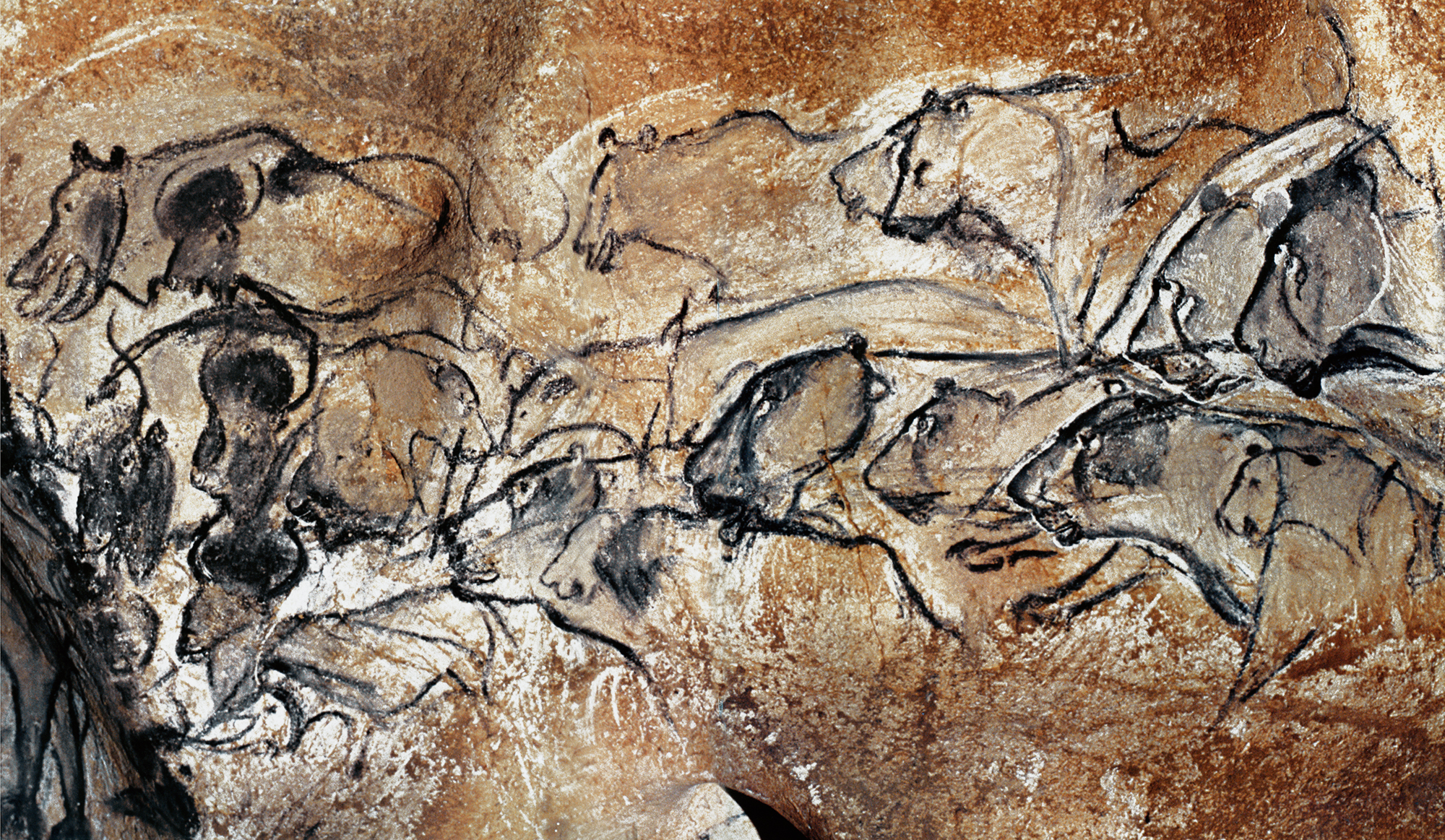
Jean turned me around to look at the left-hand wall. Great Lions fill a panel, two black and one red, superimposed on each other. They were staring into the dark cave ahead of us. We moved slowly forward and then suddenly there was the Pride of Lions. They are majestically magnificent. The intensity of the gaze of the animals staring straight back at us said only one thing, "All those who enter here, Beware". They were ready to spring, daring us to approach the Inner Sanctum. I was quite speechless.
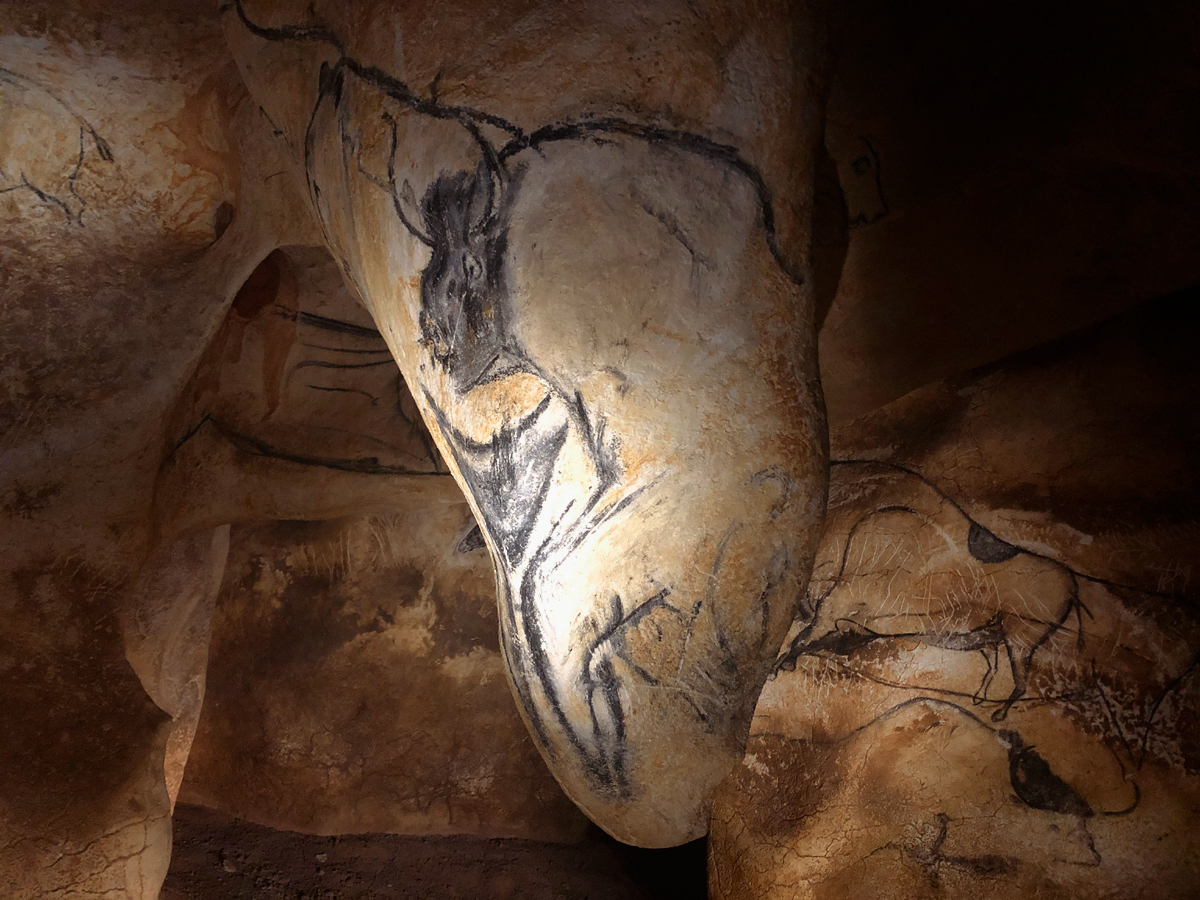
I took out my binoculars and studied the Sorcerer. The lens intensified the light and made the figure leap into life. I was in the presence of a Deity living on Earth. He radiated a ferocious pagan power. I could not keep thinking that surely I was looking at the original source of the Greek legend of the Cretan Minotaur.
How did the artist reach the rock cone to do this cave painting? Certainly some kind of scaffolding must have been used. The same thing applies to the Lion and Rhinoceros panels as some of the cave paintings extend so far up the wall, they are well out of reach of a six foot high man.
Pulling my mind away from the religious connotations, I turned the glasses to study the Lions. Again the glasses intensified the images making them even more menacing. The line and shading of the cave paintings is awesome. A magnificent work of Art.
The whole canvas is nearly 30 feet long, and spread across a magnificent water worn smooth wall of ochre shades. A large Bison to the left of the panel is painted as though it is coming out of the wall, only the front half of the giant beast shows.
Beneath the Bison is a real oddity, a baby Mammoth with enormous feet. What is it doing here? It seems out of place in the over all design of the panel.
To the left of the Lions is the great panel of Rhinoceros. What a composition! It is out of this world. I counted eight great bodies, but there could be another 6 beasts hidden in the complexity of the drawing, as the top Rhinoceros is extraordinary. He is shown as having seven enormous front horns making it look as though the animal is thrashing his head up and down in anger.
Between the Lions and the Rhinoceros is a shallow recess like a side Chapel to the Sanctuary.
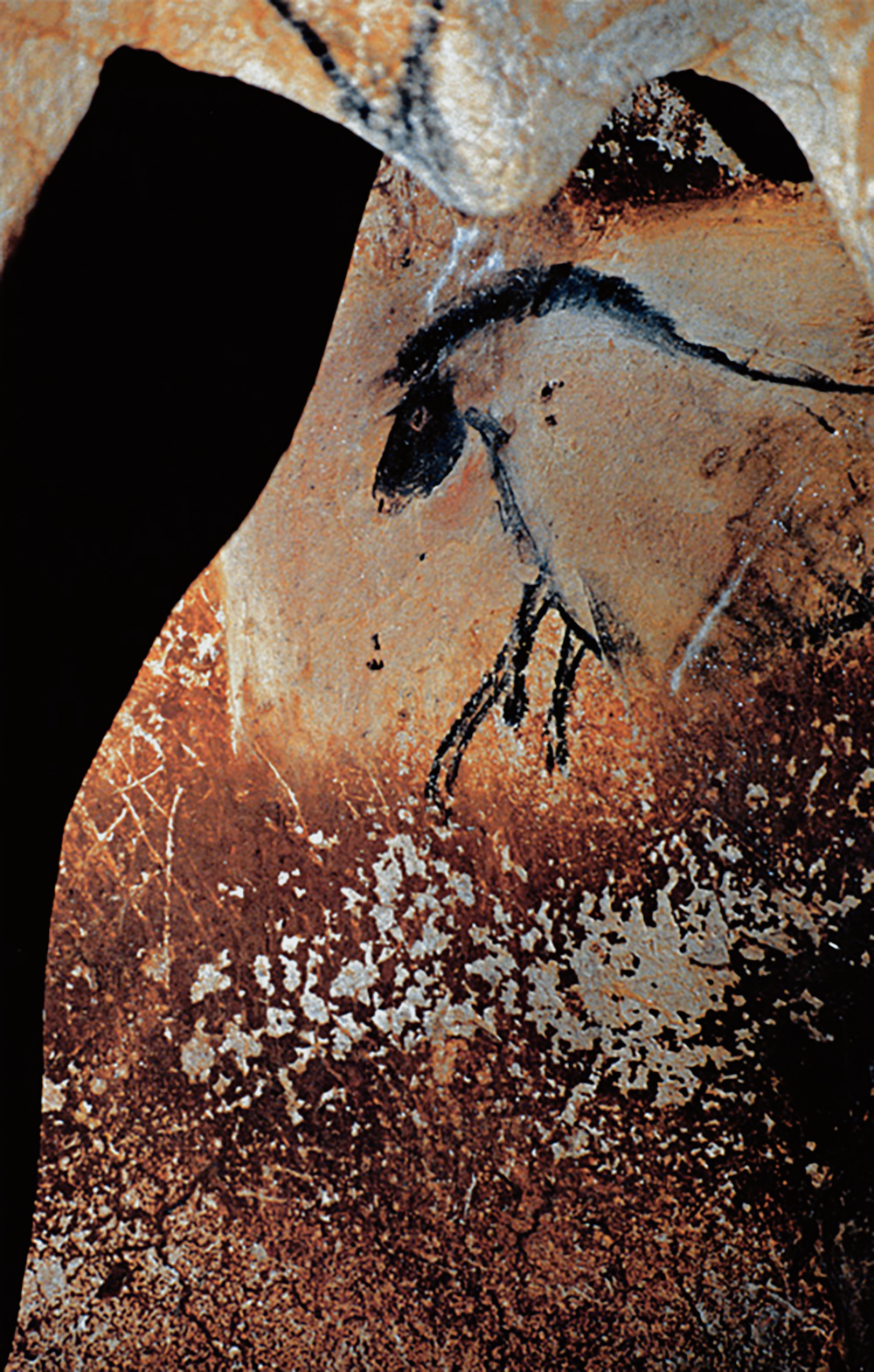
On the back wall is painted a solitary Horse, with a proudly arched mane above a black face. The body was quite orange in the light of my lamp. His back legs look as though they are hidden by undergrowth, so I got the feeling that he was walking out of the wall. What a masterpiece of drawing. What a feat of imagination.
The air in the Sanctuary is dangerously high in CO2, as it collects here because of being the lowest point of the cavern, and causes the symptoms that I was beginning to feel, tightness in my head and breathlessness. I wondered if this had been so 30,000 years ago? If so the visitors would have felt the same way as I did now. Surely this would have conveyed the feeling of sacredness to the chamber, presenting a physical barrier to the Underworld, by causing giddiness, followed by collapse.
It was time to turn and leave. Before heading back Jean showed me a large cave-in of the floor behind the Sorcerer. There at the bottom of the pit was an enormous bear skull, the largest found in the Chauvet Cave. We climbed back up the entrance of the Sanctuary, passed under the Owl, and returned to the ladders.
I stepped out into the late afternoon sunshine and took a deep breath of fresh sweet air. The view was glorious. The wall of the Canyon across the valley on the other side of the river was pitch black against a pinky blue sky. I was reminded of photographs of the famous Guilin Mountains in southern China. It was as though Nature had purposely blessed this whole area, here outside in the Canyon, and inside in the Cavern, so that man could have a special place to leave his special mark that has no equal.
I returned to the Hotel to share my experiences with Margie, have a strong drink, and a hot bath. Next morning I met Jean again in the car park, and set off up the track with him to the Chauvet Cave. It was drizzling and swirling mist again filled the valley. We soon arrived at the entrance, changed into our overalls, and once inside, pulled on our rubber shoes. I set off to crawl down the tunnel, and then climbed down the ladder, feeling quite at home.
This morning Jean had a meeting with Bernard at the Horse panel. Bernard had been recording the panel in detail, and Jean was to check his work with him. The job would take at least two hours. While they were working I was free to sit and watch. Nothing could have pleased me more as it meant that I would be alone for two hours in the Chauvet Cave with my own thoughts.
We reached the Horses and I found a comfortable seat where the plastic path branched off to the entrance of the Holy of Holies. I could see the men working about 30 feet away, their helmet lights flicking back and forth across the Horses, and could just hear them talking to each other in French. I was virtually alone. I opened my sketchbook and started to draw them as they worked.
I then drew the Horses, Aurochs, Rhinoceros, and the Chagall Horses. It was a wonderful feeling to be sketching these great works of art, and gave me a sense of communicating with the artists.
I sat with my back to the entrance of the Sorcerer Sanctuary and looked out into the great Hillaire Chamber, and slowly swung my light across from side to side. The chamber is vast. Beautiful stalagmites rose from the floor, sometimes meeting, but often not, the stalactites that hung from the roof. I took out my binoculars and started to examine my surroundings.
I suddenly realised that the Owl was looking back towards me over his shoulder and straight at the Sorcerer’s Sanctuary entrance. Surely he must have been placed here for that purpose? I turned the binoculars back towards the Horse panel to watch Jean and Bernard working at the face. They had moved down the panel to the right so I now had a clear view through the natural entrance to the Altar Chamber. I focused in on the Bear skull and suddenly realised that from where I was sitting, through the glasses, the shape of the Altar itself was like a giant Bear skull!
Standing by the Altar in the light of a helmet torch, one tends to only see the skull, plus, you are looking down on the top of the rock from a standing position. Sitting down I was looking at the side of the rock, with less light, because I was further away, the real skull almost disappeared. Through the glasses it really did look like a gigantic Bear skull.
The reason the rock looks like a skull through the binoculars is because at the base of one of the faces, there is a second rock sticking out that looks like the nose bone of the skull, leaving the large rock to resemble the cranium.
The rock itself is quite unique. I hadn’t seen anything else like it in the rest of the Chauvet Cave. The walls of the caverns are smooth being water worn. The rest of the formations are smooth and covered in calcite. The Altar is different, being a straight sided and flat topped. If it was not for the fact that you can see where it came from on the ceiling, you would say it had been quarried.
The other thing about the rock is its position in the chamber. It is right in the middle of the roundish calcite covered floor, backed by the grey clay bench area that almost looks like an auditorium set behind the altar. If this is all in place by chance then one really does marvel at such a fortunate accident. To add to the whole extraordinary resemblance, the skull has been exactly orientated to the shape of the rock by whoever put it there.
As I sat looking into the dark recesses of the Chauvet Cave, I tried to imagine what it would have been like 30,000 years ago. Slowly a scene started to formulate in my mind’s eye. The Chauvet Cave Clan was coming towards me, walking to the sound of a drum, their pine torches burning brightly. They filed past me, led by an Old Woman with grey hair. There were about twenty of them. men, children, and women, one carrying a baby. They were bare headed and warmly dressed in fitted skins. Their faces were modern, and their hair black. As they passed the Horse panel the held their burning torches high so they could see the cave paintings.
These Clan members did not know that some of the cave paintings were already 5,000 years old. They did know that the first ones had been done on the orders of the Great One, who had led the Clan away from the Salt Sea, up the river that flowed from the Land of Ice.
It was He who had taught the Clan to follow the migrating herds of Bison. It was He who had decreed that the Cave by the great Lion Arch over the river was to be the sacred Sanctuary of their Clan, where sacred rituals would be performed to enhance man's courage and women's fertility.
At night around the fire, the Clan had listened again and again to the Old Woman telling them stories about the Great One, and the wonderful things that He had done. How He had found the Cave and planned the Sanctuary. How He had ordered the cave paintings to be started, and planned the ceremonies that must be followed to select the Chief and Initiate the Women. It was He who had made the Laws of the Clan, which if followed faithfully, would ensure their survival. Now it was time to choose the new Chief, the strongest hunter, killer of the Bear, and his Wife, who would be blessed by the Bison Sorcerer, so the Clan would prosper and grow.
I watched the Clan file through the entrance into the Altar chamber, and moved around to the bench at the back of the chamber. Some of the women carried furs, which they spread over the clay seat before sitting down. The drum stopped and a hush fell upon the Clan as they waited.
The Old Woman stood by the Altar with a torch burning brightly in her hand. She called out a name and a man stood. I could see that he was carrying a bear skull. The Old Woman took the skull that was on the Altar and threw it to one side. The clatter of bone on the calcite floor echoed around the chamber. The man stepped forward, gave the skull from the Bear he had killed to the Old Woman, who then raised it for all to see, before laying it on the Altar. A shout of approval came from the watching clan.
The Old Woman gave an order and a boy sprang up, took a torch, and disappeared into the back of the cave, to quickly return carrying in his free hand a Bison horn full of water. The Old Woman took it, held it high, and then tipped it over the man's head as he knelt before her. The new Chief had been chosen and anointed. He rose, faced the Clan and raised his arms in salute. Again the Clan shouted their approval.
The Old Woman then called again a name. This time a young woman stepped forward. She was beautiful, with long hair bound in a plait that hung down her back. The Old Woman took her hand and led her back past the Horse panel towards me, and then up to the entrance of the Holy of Holies.
Each was carrying a torch and from the light I could see the young woman looking at the cave paintings on the walls. She was not frightened but held the Old Woman's hand tightly. They descended into the cavern and disappeared. The Old Woman laid the fur she was carrying in front of the Sorcerer, and the young woman knelt on it facing the Man Bison, the Sorcerer.
There was complete silence in the Chauvet Cave as the Clan watched, and waiting for the return of the women. When they appeared at the entrance of the Sanctuary, a great shout went up. The young woman carried the fur, but her plait no longer hung down her back, as it was now lying across the giant Bear skull which the Great One had placed there five thousand years ago when he founded the clan. She walked ahead of the Old Woman, who would teach her the secret ceremony of the Bear Cult.
With a signal from the Old Woman the drum started to beat slowly again. The Clan rose and started to file out of the chamber past the Bear Altar. The Initiation ceremony was complete. The Clan was reborn.
I watched as they passed by me, this time the Old Woman was last. As she passed under the Owl she held her hand up in a farewell salute. The sound of the drum got fainter and the flickering torches disappeared. I was once again left alone in the dark of the Chauvet Cave.
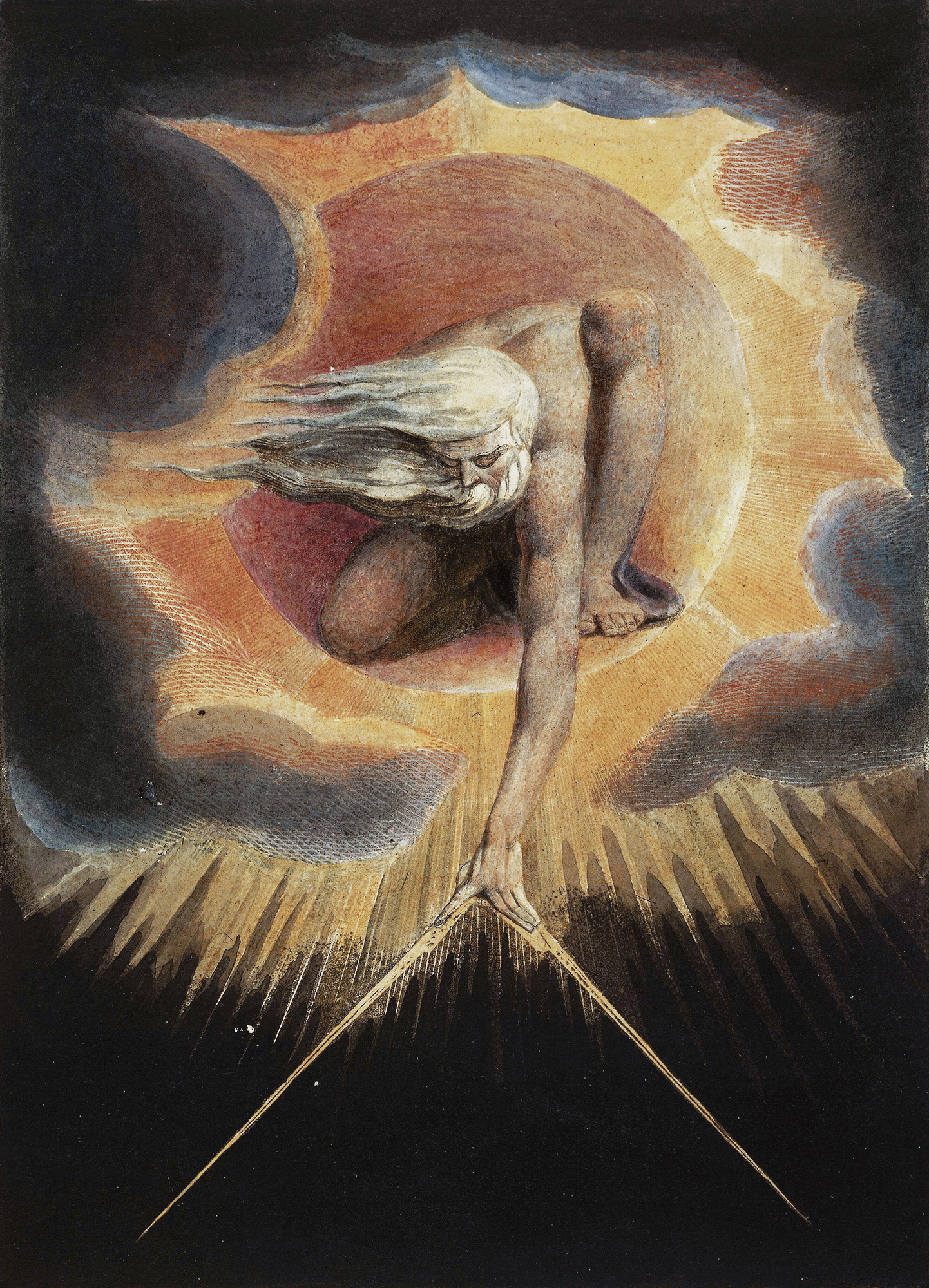
Man is a puny, slow, awkward, unarmed animal - he had to invent the pebble, a flint, a knife, a spear.
But why to these scientific inventions, which were essential to his survival, did he come to caves like this, and make paintings of animals in places that were dark, secret, remote, hidden, inaccessible? I think that the power that we see expressed here for the first time is the power of anticipation: the forward-looking imagination.
Art and science are both uniquely human actions, outside the range of anything that animal can do. And here we see that they derive from the same human faculty: the ability to visualise the future, to foresee what might happen and plan to anticipate it, and represent it to ourselves in images that we project and move inside our head.
What we call cultural evolution is essentially a constant growing and widening of the human imagination.
- Chauvet Cave
- Chauvet Cave Granted UNESCO World Heritage Status
- Introduction to the Chauvet Cave Paintings
- Chauvet Cave Gallery
- The Venus & The Sorcerer
- Frequently Asked Questions
- Frequently Asked Questions
- L'Atlas de la grotte Chauvet-Pont d'Arc
- Preserving the Chauvet Cave
- The Final Passage
- Cave of Forgotten Dreams
- Chauvet Cave Visit 2005
- Chauvet Cave Visit 2001
- Chauvet Cave Visit 1999