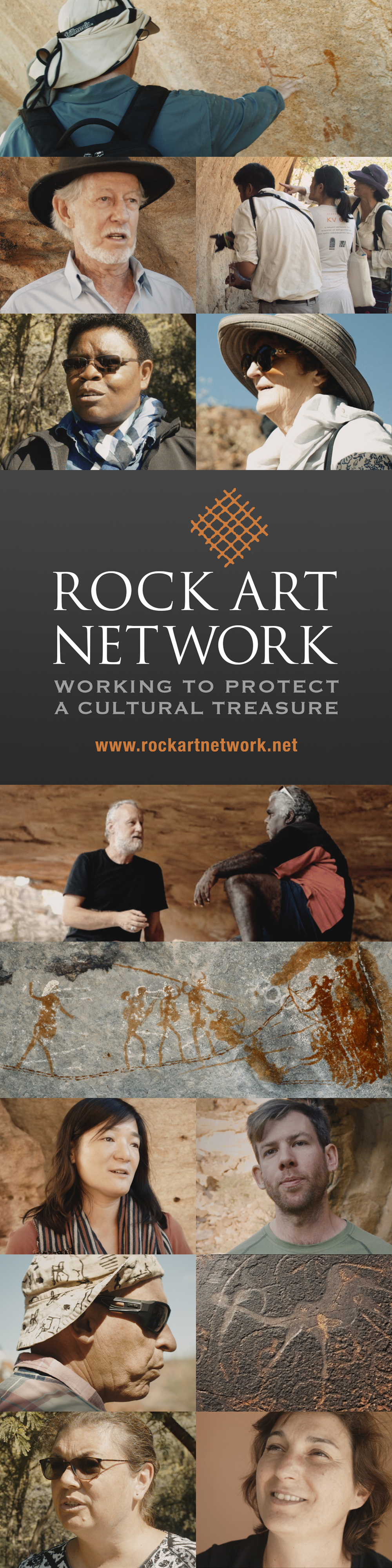
This has been the third colloquium of the Rock Art Network, organised by Neville Agnew of the Getty Conservation Institute in Los Angeles, consisting of rock art researchers and associated professionals from around the world. It follows on from the 2 previous colloquia: the 2017 Namibia colloquium 'Art on the Rocks - A Global Heritage' and the 2018 United States colloquium 'Art on the Rocks - Developing action plans for public and professional networking' held in California and Texas. The 2019 France and Spain colloquium ‘Replication as Conservation: Chauvet, Lascaux, Altamira’ held presentations and discussion groups, interspersed with visits to caves and cave replicas.
The Rock Art Network group met at Vagnas in the Ardèche, the Auvergne-Rhône-Alpes region of Southeastern France. From here we were able to visit Chauvet 2, the replica of the Chauvet Cave. We were hosted by Jean-Michel Geneste, the former curator of the Lascaux Cave as well as the director of its scientific research program, and director of the multidisciplinary research program of Chauvet 2.
This has been the third colloquium of the Rock Art Network, organised by Neville Agnew of the Getty Conservation Institute in Los Angeles, consisting of rock art researchers and associated professionals from around the world. It follows on from the 2 previous colloquia: the 2017 Namibia colloquium 'Art on the Rocks - A Global Heritage' and the 2018 United States colloquium 'Art on the Rocks - Developing action plans for public and professional networking' held in California and Texas. The 2019 France and Spain colloquium ‘Replication as Conservation: Chauvet, Lascaux, Altamira’ held presentations and discussion groups, interspersed with visits to caves and cave replicas.
The Rock Art Network group met at Vagnas in the Ardèche, the Auvergne-Rhône-Alpes region of Southeastern France. From here we were able to visit Chauvet 2, the replica of the Chauvet Cave. We were hosted by Jean-Michel Geneste, the former curator of the Lascaux Cave as well as the director of its scientific research program, and director of the multidisciplinary research program of Chauvet 2.
Chauvet 2 has been divided into 4 sections
- 1. Hillaire Chamber, panel of the Horses
- 2. Candle Gallery
- 3. Cactus Gallery
- 4. End Chamber, panel of the Lions

The virtual cave segues neatly into the Aurignacian Gallery. Embracing the life of our ancestors, we learn about life in the cold steppe at the time of the last ice age and where the Aurignacians came from.
After Chauvet 2 the Rock Art Network group was given permission to hike up to the entrance of Chauvet itself. Leaving the vineyards on the floodplain, a small rocky path leads steeply up through the woods before emerging on a wide and natural ledge in the cliff. The path resumes its wooded coarse before finally arriving at the well-secured entrance of the cave. Here Jean-Michel Geneste and Jean-Jaques Delannoy [Geomorphologist, member of the scientific team and director of EDYTEM interdisciplinary laboratory] presented various explanations of Chauvet in its natural geomorphological setting over time. Having spent the morning inside Chauvet 2, the natural and cultural wonders behind the steel door seemed much more comprehensible.
Moving from the Ardèche we travelled to Les Eyzies-de-Tayac-Sireuil in the Dordogne. From here the Rock Art Network group visited the decorated caves of Font de Gaume, Les Combarelles, Rouffignac, Cougnac and Pech Merle. These caves - all open to the public - are magnificent in their own individual way.


Following this, the group visited Lascaux 4, the replica of Lascaux Cave, again hosted by Jean-Michel Geneste. Lascaux 4 and the International Centre for Cave Art opened to the public on 15 December 2016 on a site down the hill from the original cave. The guided tour of the virtual cave begins by entering a Rotunda - the great Hall of the Bulls with its 130 figures. The visitors then wind their way through a labyrinth of tunnels and passageways, including the famous Axial gallery and the Nave.
The visitor then moves through a dramatic architectural area which serves as a transitional space before entering the Lascaux Workshop with sections of the cave exhibited in 3D at a 1:1 scale. Here visitors can deepen their knowledge using an interactive "companion" - a kind of iPhone specifically designed for the site. Ultimately, a visit into Lascaux 4 combines emotion and knowledge.
Following this, the group visited Lascaux 4, the replica of Lascaux Cave, again hosted by Jean-Michel Geneste. Lascaux 4 and the International Centre for Cave Art opened to the public on 15 December 2016 on a site down the hill from the original cave. The guided tour of the virtual cave begins by entering a Rotunda - the great Hall of the Bulls with its 130 figures. The visitors then wind their way through a labyrinth of tunnels and passageways, including the famous Axial gallery and the Nave.
The visitor then moves through a dramatic architectural area which serves as a transitional space before entering the Lascaux Workshop with sections of the cave exhibited in 3D at a 1:1 scale. Here visitors can deepen their knowledge using an interactive "companion" - a kind of iPhone specifically designed for the site. Ultimately, a visit into Lascaux 4 combines emotion and knowledge.
Onwards into northern Spain's Cantabria with a dramatic change in scenery. First stop is the Ekainberri Museum, the replica located 600 m from the cave of Ekain which houses paintings and engravings created some 14,000 ago, and given World Heritage status in 2008.

The Rock Art Network group then visited the Museum of Altamira - Museo Nacional y Centro de Investigación de Altamira - located beside the Cave of Altamira. The group was hosted by the museum's Director Pilar Fatás, herself a member of the Rock Art Network.
The Museum of Altamira is a splendidly designed building devoted to learning of, enjoying and experiencing the life of those who painted and inhabited the cave of Altamira. The reproduction of the cave - the Neocave - presents Altamira as a Palaeolithic venue, a habitation site and a sanctuary. This meticulous and exact reproduction, made in full scale, reconstructs the cave of Altamira as it was between 22,000 and 13,000 years ago, when it was inhabited by groups of hunter-gatherers. The remains of everyday life of its inhabitants can be found in the museum's exhibition area, where there are large collections of fauna, shells, charcoals, and utensils made out of flint stone, antler and bone, as well as the remains of pigments and objects of furniture that provide information about their way of life.
'Color and power: rock art of San hunter gatherers in Ukhahlamba-Drakensberg'. The visit coincided with the new exhibition at the Museum of Altamira, displaying images of the cave paintings of Ukhahlamba-Drakensberg - which has the greatest concentration of this type of art - as well as objects of the San material culture. The exhibition is the result of collaboration between 2 members of the Rock Art Network, our host Pilar Fatás and Aron Mazel, archaeologist and researcher at the University of Newcastle in Britain.
Our final cave visits included El Castillo and Las Monedas, both housing exceptional examples of cave art. Indeed, the 10 Cantabria caves comprise a World Heritage Site declared by UNESCO; Altamira, Chufín, Hornos de la Peña, Las Monedas, El Castillo, Las Chimeneas, La Pasiega, El Pendo, La Garma and Covalanas.
- San rock art exhibition at the National Museum & Research Center of Altamira
17 September 2019
by Aron Mazel - Altamira and the New Technology for Public Access
30 April 2017
by Pilar Fatás - From the Chauvet Cave to the Caverne du Pont d’Arc: Methods and Strategies for a Replica to Preserve the Heritage of a Decorated Cave That Cannot Be Made Accessible to the Public
29 April 2017
by Jean-Michel Geneste
- Chauvet Cave
- Chauvet Cave Granted UNESCO World Heritage Status
- Introduction to the Chauvet Cave Paintings
- Chauvet Cave Gallery
- The Venus & The Sorcerer
- Frequently Asked Questions
- Frequently Asked Questions
- L'Atlas de la grotte Chauvet-Pont d'Arc
- Preserving the Chauvet Cave
- The Final Passage
- Cave of Forgotten Dreams
- Chauvet Cave Visit 2005
- Chauvet Cave Visit 2001
- Chauvet Cave Visit 1999